
Concrete is the most widely used construction material, and most of its carbon footprint comes from a single ingredient: clinker, the base of cement. Under France's RE2020 regulation, cutting that footprint is no longer optional for new buildings. So-called "low-carbon" concrete has become a design topic in its own right, for the structural engineer as much as for the contractor.
Why it can no longer be ignored
RE2020 measures the carbon impact of new buildings with the Ic construction indicator, in kg CO2e/m², based on a 50-year life cycle assessment. The thresholds tighten in steps. For multi-family housing, the cap falls from 740 kg CO2e/m² in 2022 to 650 in 2025, 580 in 2028 and 490 in 2031. For single-family homes: 640, then 530, 475 and 415.
The structure weighs heavily in this balance. The French construction quality agency AQC quotes about 188 kg CO2e/m³ for an unreinforced C25/30 ready-mix concrete, and notes that with about 150 kg of steel per m³, the rebar's impact is of the same order as the concrete's.
What does "low-carbon concrete" mean?
There is no standard or regulatory definition of low-carbon concrete. By convention, it is a concrete with performance equivalent to a reference mix but lower greenhouse gas emissions. The main lever is to replace part of the clinker with lower-emission constituents:
- ground granulated blast-furnace slag, in CEM III cements;
- limestone, fly ash and pozzolans, in CEM II cements;
- calcined clays combined with limestone, in LC3 cements;
- the low-clinker cements of EN 197-5 (CEM II/C-M and CEM VI).
The differences are large. According to figures reported by OPPBTP, the French construction safety body, a CEM I emits about 694 kg CO2/t, a CEM II/A or B between 570 and 450, a CEM III/A between 330 and 450, a CEM III/B about 311 and a CEM III/C as little as 198 kg CO2/t.
Four families, four levels of maturity
- Concretes complying with NF EN 206/CN: typically 20 to 40% lower emissions than a CEM I reference. The most common and the easiest to get approved.
- Performance-based concretes: they push binder optimisation further, but must be planned early and backed by testing.
- Clinker-free activated slag: outside the scope of NF EN 206/CN. Some now hold a French Technical Assessment (Avis Technique), such as H-UKR cement for foundations and superstructure, which lets them be treated as a standard technique within their scope of use. Others remain usable case by case under a site-specific technical approval (ATEx).
- Emerging binders (sulfoaluminate, geopolymers): still largely at R&D stage.
Outside the standards, a concrete counts as a non-standard technique: the insurer must be consulted before use.
What changes on site
Less clinker also means slower strength gain. A CEM I reaches about 18 MPa at 24 hours, versus about 4 MPa for a CEM III/B. The consequences are direct:
- longer striking times: the concrete must reach sufficient strength (around 5 MPa to avoid edge spalling) before formwork is removed, and about 20 MPa before a precast slab is lifted;
- longer curing, or a curing compound, and greater sensitivity to shrinkage cracking;
- cold-weather precautions: at 5 °C a CEM III can stay around 1 MPa, which is why faster cements are still used in winter on some sites;
- tighter control: crew training, early-age strength measurement and inspection plans followed to the letter.
The main risk is not the material itself, but a programme designed for conventional concrete applied to a slower one.
What changes for the structural engineer
- Design: the cement class (S, N or R) enters Eurocode 2 for strength development over time, creep and shrinkage. The calculation assumptions must match the binder actually specified.
- Durability: a low-carbon concrete complying with NF EN 206/CN raises no particular risk if execution follows NF EN 13670/CN, curing included. The exposure class remains the starting point, especially for carbonation (XC classes).
- Specifications: they must state strength and exposure classes, but also execution constraints (striking rates, phasing, season) and non-structural requirements (fire, thermal, appearance).
- Non-standard concretes: testing is needed to show that Eurocode 2 rules still apply, with checks on fire, seismic behaviour and durability.
Design is still the first lever
Changing the cement is not enough. The lowest-carbon concrete is the concrete you don't pour. At building scale, optimising the structure often matters as much as the choice of binder:
- a regular structural grid and suitable spans;
- slab and wall thicknesses that are justified, not repeated out of habit;
- optimised sections and reinforcement ratios, since steel weighs as much as concrete in the balance;
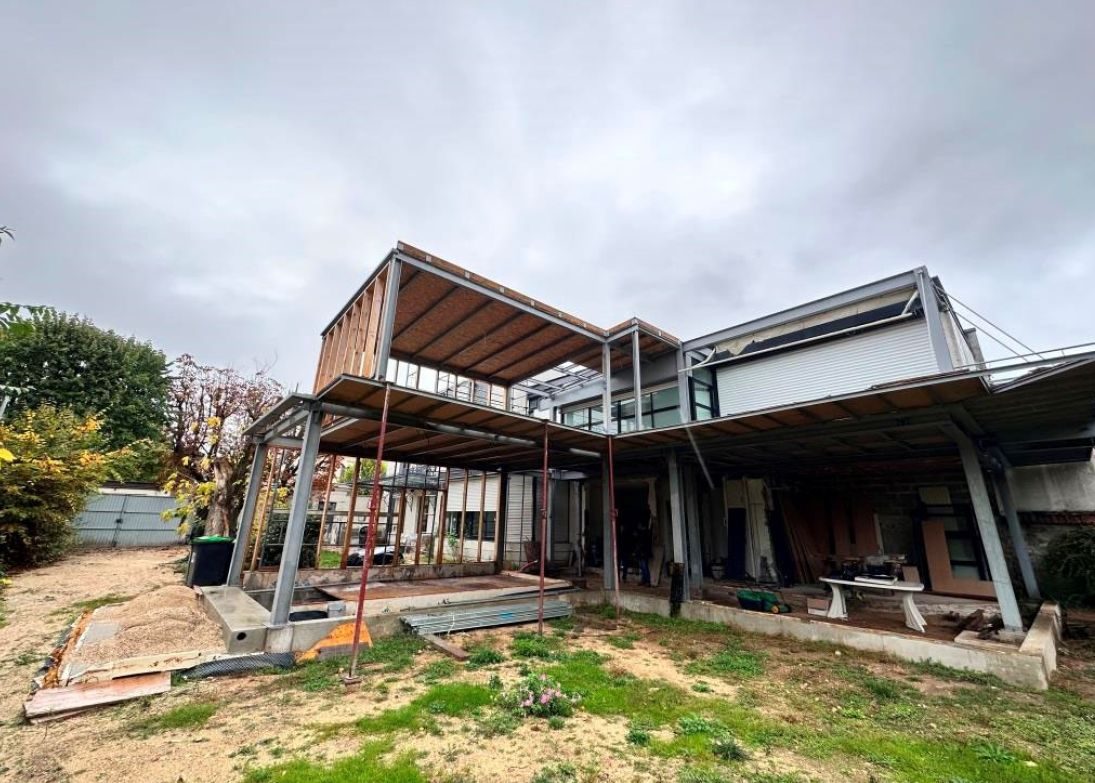
- hybrid structures (concrete, timber, steel) where the brief allows.
Outside France, the same levers apply even without a regulatory threshold; only the availability of low-clinker cements varies from one market to another.
At COFEC INTERNATIONAL, we build these parameters in from the design stage: cement assumptions in the calculation note, optimised sections and clear requirements in the specifications.